Berlin Airlift by Jon Sutherland & Diane Canwell
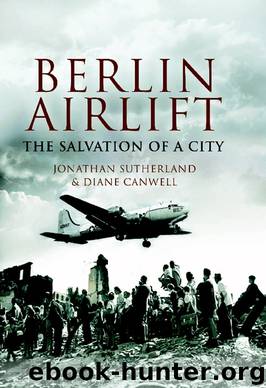
Author:Jon Sutherland & Diane Canwell
Language: eng
Format: epub
ISBN: 9781781594483
Publisher: Pen and Sword
Published: 2013-01-07T16:00:00+00:00
CHAPTER SIX
Airlift Airbases
At the peak of the airlift operations aircraft were airlifting supplies into three airfields in Berlin and using nine bases in the western zones. It was abundantly clear that the central and northern corridors into the city were the shortest routes. They were also not very far above sea level compared to the southern corridor in the US zone. As a result, by October 1948 the airlift was predominantly using airfields in the British zone, of which there were six: Bückeburg, Fassberg, Fuhlbuttel, Lübeck, Schleswigland and Wunstorf. Soon two others would be used in the British zone, including the old seaplane base at Finkenwerder and another airbase at Celle. By this stage only a pair of airfields were being used in the US zone, Rhein-Main and Wiesbaden.
The Americans had standardized their fleets to use the C-54s, each of which could carry 10 tons per sortie. In all, they were carrying 3,000 tons into Berlin each day. This compared to the mixture of military and civilian aircraft being used by the British that were lifting around 1,500 tons. It made perfect sense, therefore, to shift the main American effort from the southern bases to the shorter bases in the British zone. The first to be converted to American use was Celle. American aircraft were already operating out of Fassberg and Lübeck. Bückeburg was working as a passenger shuttle base, connecting Berlin with Great Britain.
The Combined Airlift Task Force produced a manual in December 1948, entitled Airlift Routes and Procedures. This gave pilots a chart for all airlift bases, as well as approach charts for twenty-six bases around Europe.
The French had a distinct lack of transport aircraft. Most of their Douglas C-47 Transporters were being used in Indo-China. For a short period they operated three Junkers JU52s out of Wunstorf, but their contribution to the airlift ended abruptly when two of the Junkers crashed into one another. They then offered a site in the Wedding suburb, which became Tegel airfield (see below).
Tempelhof airport was a huge air terminus. It had a massive curving operations and administrative block, which had been constructed between 1934 and 1939. At the time the structure was said to be the third largest building in the world. It had served as a factory, producing Focke-Wulf Fw 190 fighter aircraft. It also had a well-equipped hospital. It was, in effect, originally designed to be the city’s principal civil airport.
For a short time, it had been occupied by the Soviet 515th Fighter Air Regiment, then by the 193rd Fighter Air Division. It was the Soviets who had laid a pierced steel planking runway, extending to 4,987 ft by 120 ft.
The Americans took possession on 2 July 1945. There had been extensive damage and anything that was not concreted into the ground had been taken. The pierced steel planking had been laid on a relatively unstable foundation, making landing in poor weather hazardous.
Tempelhof was situated on a flat area in the middle of the city. The approach had to
Download
This site does not store any files on its server. We only index and link to content provided by other sites. Please contact the content providers to delete copyright contents if any and email us, we'll remove relevant links or contents immediately.
| Africa | Americas |
| Arctic & Antarctica | Asia |
| Australia & Oceania | Europe |
| Middle East | Russia |
| United States | World |
| Ancient Civilizations | Military |
| Historical Study & Educational Resources |
Cat's cradle by Kurt Vonnegut(15351)
Pimp by Iceberg Slim(14506)
4 3 2 1: A Novel by Paul Auster(12391)
Underground: A Human History of the Worlds Beneath Our Feet by Will Hunt(12097)
The Radium Girls by Kate Moore(12028)
Wiseguy by Nicholas Pileggi(5782)
The Fire Next Time by James Baldwin(5442)
Perfect Rhythm by Jae(5402)
American History Stories, Volume III (Yesterday's Classics) by Pratt Mara L(5307)
Paper Towns by Green John(5189)
Pale Blue Dot by Carl Sagan(5007)
A Higher Loyalty: Truth, Lies, and Leadership by James Comey(4960)
The Mayflower and the Pilgrims' New World by Nathaniel Philbrick(4502)
The Doomsday Machine by Daniel Ellsberg(4490)
Killers of the Flower Moon: The Osage Murders and the Birth of the FBI by David Grann(4447)
The Sympathizer by Viet Thanh Nguyen(4390)
Too Much and Not the Mood by Durga Chew-Bose(4347)
The Borden Murders by Sarah Miller(4325)
Sticky Fingers by Joe Hagan(4197)
